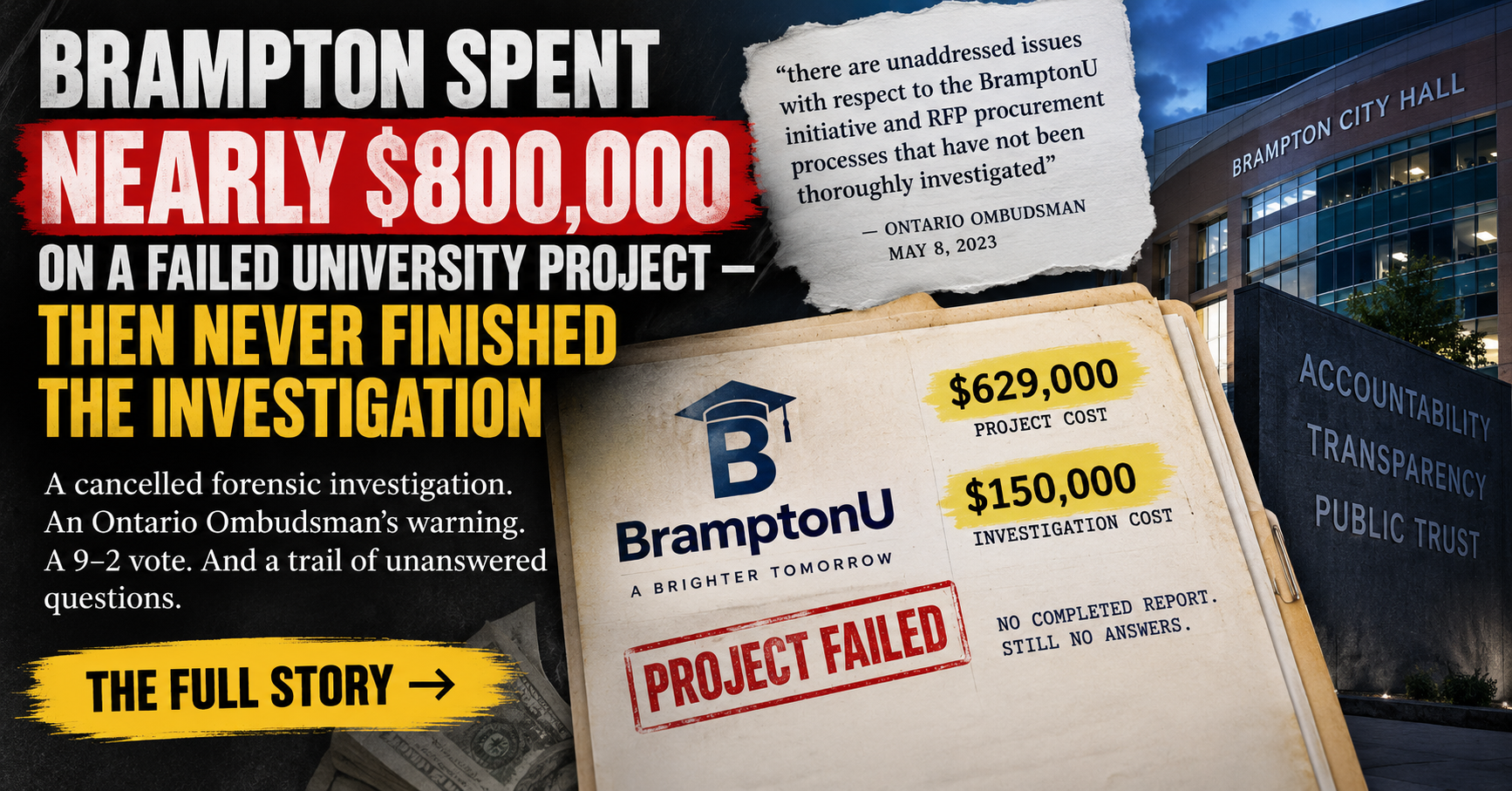
BramptonU Cost Nearly $800,000. Then the Investigation Was Never Finished.
Brampton taxpayers spent roughly $629,000 on the BramptonU project. The City then spent another roughly $150,000 on a forensic investigation into what happened.
That investigation was never completed.
In August 2022, Brampton City Council terminated the forensic investigations before investigators had finished their work and accepted an interim report as the final report.
Months later, the Ontario Ombudsman reviewed complaints about the decision and said there were unresolved issues concerning BramptonU and the City’s procurement processes that had not been thoroughly investigated. The Ombudsman’s office encouraged the City to revisit the decision and address the outstanding concerns.
According to The Pointer’s reporting in April 2026, no new investigation was commissioned to replace the one that was terminated.
That decision is where this story begins.
The BramptonU project cost $629,000
Brampton wanted to establish a university.
The project became known as BramptonU, and the City eventually spent approximately $629,000 pursuing it.
The fact that the university failed does not, by itself, mean that money was improperly spent. Governments pursue projects that don’t succeed all the time.
The questions surrounding BramptonU were more specific.
Among the things that eventually came under scrutiny were whether contracted work had actually been performed, whether the City received the deliverables it paid for, whether invoices and payments were properly handled, whether procurement rules had been followed and whether there were potential conflicts of interest.
A City investigation was therefore not simply asking why the university failed. It was looking at how the money had been spent and how the contracts had been awarded and administered.
Brampton had already been warned about procurement
The BramptonU controversy did not emerge in isolation.
In 2016, Ontario Ombudsman Paul Dubé investigated Brampton’s procurement practices. His 2017 report, Procuring Progress, made 15 recommendations intended to improve procurement, transparency and accountability.
One of those recommendations was that Brampton consider establishing a permanent, independent municipal Auditor General.
Brampton had previously had an interim Auditor General. That auditor examined the City’s Southwest Quadrant project, and the Ombudsman excluded that project from his own investigation because it had already been comprehensively reviewed.
What Brampton did not establish was a permanent independent Auditor General providing that oversight on an ongoing basis.
That history matters because, several years later, Brampton once again found itself relying on a special outside investigation to examine questions about municipal procurement.
May 2022: Council orders a forensic investigation
In May 2022, Council authorized a forensic investigation into the BramptonU matter.
The firm selected was Froese Forensic Partners.
The purpose was to independently examine the contracts and the circumstances surrounding them. Among the questions being investigated were whether the contracted work had actually been performed, whether deliverables had been received, whether invoices and payments were reasonable and whether potential conflicts of interest existed.
The investigation was not simply a review of the final outcome of BramptonU. Council wanted questions surrounding the procurement and administration of the project examined as well.
June 2022: The investigation was already being contested
The investigation itself quickly became the subject of disagreement at Council.
A three-member steering committee — Councillors Pat Fortini, Gurpreet Dhillon and Jeff Bowman — was established to oversee the forensic work. At a June 2022 special meeting, councillors debated the role of the committee and whether it should have direct involvement with the forensic firm.
The motion to proceed with the investigation under the steering committee’s management passed 6–5.
According to The Pointer’s contemporaneous reporting, the questions being considered included how the BramptonU initiative originated, how the RFP was developed, how consultants were selected, who was responsible for ensuring the contracted work was completed, how the budget increased, why payments were made despite questions about incomplete work, and whether councillors had engaged in outside lobbying.
The investigation was moving forward, but there was already disagreement over how it should be conducted.
Then came August.
August 17, 2022: The investigators say they’re not finished
On August 17, Froese provided Council with a draft status update.
It was not a final report.
The investigators still had work to do, including additional interviews and further examination of issues involving City policies and potential conflicts of interest. The Pointer reported that the investigators were still expecting to interview people including Rob Godfrey, David Wheeler and Councillor Rowena Santos, along with other City employees.
The investigation was also examining potential conflicts involving Mayor Patrick Brown and consultant Rob Godfrey, as well as the relationship between Santos and David Wheeler.
The investigators had not finished their work.
Nine days later, Council called a special meeting.
August 26, 2022: Council ends the investigations
On August 26, Council met to discuss the forensic investigations.
There were actually six investigations on the table, not just BramptonU. They involved other City procurements and hirings as well.
Council voted to terminate them.
For the BramptonU investigation, this meant Froese would not complete the forensic work it had been hired to perform. Council instead directed that further work cease and received the draft report as final.
The timing is important because the investigation had been expected to continue into September. The forensic firm’s work had not reached its intended conclusion when Council brought it to an end.
Froese subsequently made clear that its August material was not intended to be a final report. The firm stated that it had been unable to complete its forensic review because Council had directed it to stop its work on August 26.
What had the investigators found?
This is where the story gets considerably more complicated than simply saying the investigation was cancelled.
Froese’s work had already raised questions about the procurement process.
The investigators reported that they did not have sufficient information to conclude that all of the contracted work had actually been performed. They also identified concerns surrounding the procurement process and potential conflicts of interest.
One of the contracts involved Stakeholder Research Associates, with Rob Godfrey involved in the work.
The original contract was valued at approximately $170,000. Subsequent payments increased the amount paid to the company to more than $500,000, according to the financial records discussed in the reporting.
Another consultant, David Wheeler, had a longstanding relationship with Councillor Rowena Santos. Froese’s work examined whether that relationship created a potential conflict and whether Wheeler had received information or assistance that wasn’t available to other bidders.
These findings should not be confused with a completed determination of wrongdoing. The investigators hadn’t finished their work.
That is precisely why the unfinished nature of the investigation matters.
The Integrity Commissioner was not a replacement for the forensic investigation
There was another accountability process running alongside the forensic investigation.
Some matters had been referred to Brampton’s Integrity Commissioner.
But an Integrity Commissioner and a forensic investigator perform different functions.
An Integrity Commissioner primarily examines questions concerning the ethical conduct of members of Council and certain municipal officials. A forensic investigation can examine contracts, procurement records, invoices, payments, deliverables and other financial and documentary evidence.
After Council cancelled the forensic work, the Integrity Commissioner could not simply take over everything Froese had been investigating.
The Ombudsman’s later correspondence specifically raised concerns about what happened to the RFP audits after they were cancelled.
The audits were referred to the Integrity Commissioner, but the Integrity Commissioner determined that the complaints were outside her jurisdiction, and no further action was taken. That distinction matters because an ethics or integrity review could not simply substitute for the broader forensic examination of contracts, procurement records, invoices, payments and deliverables that Froese had been conducting.
May 8, 2023: The Ombudsman weighs in
Complaints were made to the Ontario Ombudsman about Council’s decision to terminate the investigations.
On May 8, 2023, Robin Bates, Senior Counsel with the Ontario Ombudsman, wrote to Brampton City Council.
The letter referred back to the Ombudsman’s earlier work on Brampton’s procurement practices and expressed concern about the cancellation of the forensic investigations.
The key passage is worth reading directly:
“there are unaddressed issues with respect to the BramptonU initiative and RFP procurement processes that have not been thoroughly investigated”
The Ombudsman encouraged the City to revisit its decision to cancel the audits and ensure that outstanding concerns were comprehensively investigated and addressed at the municipal level.
This is an important distinction.
The Ombudsman did not conclude that Patrick Brown, Rowena Santos or anyone else had committed fraud. It did not conduct the forensic investigation itself.
It said there were unresolved issues that had not been thoroughly investigated.
May 17, 2023: The 9–2 Vote
The Ombudsman’s letter came before Brampton City Council on May 17, 2023.
Councillor Martin Medeiros moved that the correspondence be referred to the Audit Committee.
9–2 — MOTION DEFEATED
The recorded vote was:
| Vote | Councillors |
|---|---|
| YES | Martin Medeiros, Pat Fortini |
| NO | Other members of Council |
The motion did not pass.
What passed instead was a different motion sending the Ombudsman’s correspondence to the Budget Committee and directing staff to calculate costs associated with the Ombudsman’s correspondence and explore whether those costs could be recouped.
The motion referred to the complaints as having been brought about by “false and defamatory remarks and actions against staff.”
The two motions took the issue in different directions. Medeiros’ motion would have sent the Ombudsman’s correspondence to the Audit Committee. The motion that passed instead sent it to the Budget Committee and directed staff to examine the costs associated with the correspondence and whether those costs could be recouped.
The Ombudsman had encouraged Council to revisit the cancelled audits. The proposed Audit Committee referral failed, while the alternative Budget Committee motion passed unanimously.
2023–2026: No replacement investigation
After the May 2023 Council meeting, there was no new forensic investigation that replaced the one terminated in 2022.
The Pointer reported in April 2026 that no further investigation had been commissioned and that the Ombudsman’s recommendation had not been acted upon. The outlet also reported that City staff estimated more than $150,000 had been spent on the original investigation, while its results were never released as a completed forensic report.
Fortini and Medeiros, who had pushed for the investigations to continue, had by then largely stopped pursuing the matter publicly, according to the outlet. Brown did not respond to The Pointer’s questions.
So the City was left with an unusual situation: approximately $629,000 had been spent on BramptonU, approximately another $150,000 had been spent investigating the project, the independent investigators had not finished their work, and the provincial Ombudsman subsequently said there were unresolved issues that had not been thoroughly investigated.
The investigation was not restarted.
Nearly $800,000 — and no completed investigation
The numbers are worth separating because they represent different things.
Approximately $629,000 was spent on the BramptonU project.
Approximately $150,000 was spent on the forensic investigation.
Together, that’s roughly $779,000 in taxpayer money associated with the project and the investigation into it.
The investigation itself was originally expected to cost approximately $100,000 before the expected cost rose to about $150,000 as investigators determined that more work was required.
That doesn’t mean the entire $779,000 was wasted. The forensic investigation produced information, and the investigators identified issues that warranted further examination.
But the City never received the thing it originally commissioned: a completed independent forensic investigation.
The Auditor General question never really went away
That brings us back to the 2017 Ombudsman report.
Paul Dubé had already identified the need for stronger independent oversight of Brampton’s procurement practices and recommended that the City consider establishing a permanent, independent Auditor General.
Five years later, Council was again dealing with concerns about procurement and conflicts of interest and had to commission a special forensic investigation.
Then Council itself decided when that investigation would end.
The BramptonU episode doesn’t prove that an independent Auditor General would have produced a different result. It does show why the question of independent municipal oversight exists in the first place.
If the people responsible for governing a municipality also have the authority to commission, define and terminate investigations into the municipality’s own conduct, there is a legitimate question about how independent that accountability system really is.
What I want to find out next
There are still documents worth digging through: the complete Froese file, the Integrity Commissioner’s records, the full August 2022 Council debate and the committee records following the May 2023 meeting.
Those records could help establish exactly what Council knew when it voted to terminate the investigations, what remained unfinished, and whether anything happened after the Ombudsman’s letter.
What do you make of the decisions documented in this timeline? Leave a comment below — particularly if you have additional documents or information that could help fill in the gaps.